I am pleased to share our new article: «Who gets targeted? Intersectional patterns of hate and toxicity in social media».
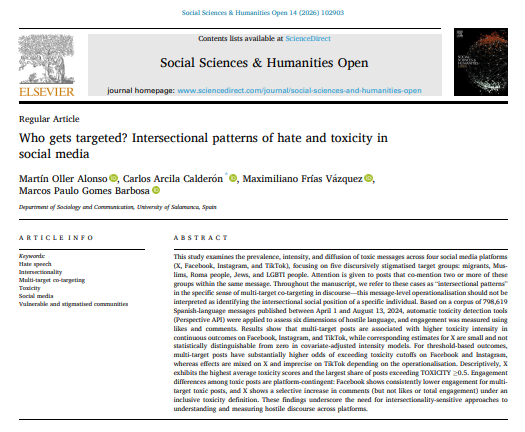
Published in Social Sciences & Humanities Open, Carlos Arcila, Maximiliano Frías, Marcos Gomes, and I examine how toxic and hostile discourse circulates across X, Facebook, Instagram and TikTok, focusing on five vulnerable and discursively stigmatised communities: migrants, Muslims, Roma people, Jews and LGBTI people.
At a time when digital platforms have become central arenas for political conflict, social polarisation and identity-based hostility, this research addresses an urgent question: who is targeted when hate does not operate along a single axis, but combines several vulnerable groups within the same message?
Based on a corpus of 798,619 Spanish-language posts published between April and August 2024, we analyse what we define as “intersectional patterns” of online hostility: posts that co-mention or co-target two or more vulnerable groups. This distinction is important. We do not claim to measure intersectionality as lived social experience, but rather message-level multi-target hostility in digital discourse.
The findings show that most posts refer to only one group. However, a relevant minority —19,896 posts, around 2.5% of the corpus— mention two or more target groups. These multi-target posts are not marginal from an analytical perspective. They help us understand how hate speech becomes more complex, more layered and, in several platforms, more toxic.
One of the most significant results is that multi-target posts are associated with higher toxicity intensity on Facebook, Instagram and TikTok. The most frequent pairing across the corpus is Islam and Judaism, while TikTok shows a different platform-specific pattern, with Islam and LGBTI as the most frequent combination. This confirms that online hate is not only group-specific but also platform-specific.
The article also shows that toxicity and diffusion do not follow a single universal pattern. X has the highest average toxicity scores and the largest share of posts above the toxicity threshold, but multi-target toxicity does not behave similarly across all platforms. Facebook, Instagram, TikTok and X each have their affordances, audiences, moderation regimes and communicative cultures.
This is one of the main contributions of the study: we need platform-sensitive and intersectionality-informed approaches to understand online hate. It is not enough to detect isolated insults against a single group. Hostility often works by connecting identities, transferring blame, linking prejudices and producing compound forms of symbolic violence.
The relevance of this work goes beyond computational social science. In the current political and geopolitical context, hostile narratives against migrants, Muslims, Jews, Roma people and LGBTI communities are not isolated phenomena. They circulate within broader ecosystems of polarisation, disinformation, fear and identity conflict. Studying how these forms of hostility intersect is essential for better moderation, public policy, and protection of vulnerable communities.
Scientifically, this article contributes to measuring online hate by combining dictionary-based group identification, Perspective API toxicity scores, and platform-comparative analysis. Socially, it reinforces a clear message: if hate is intersectional, our methods, policies and responses must also be intersectionality-sensitive.
Read the article on ScienceDirect:
https://www.sciencedirect.com/…/pii/S2590291126004687
#HateSpeech #OnlineHate #Intersectionality #SocialMedia #Toxicity #DigitalPlatforms #X #Facebook #Instagram #TikTok #Migration #Islamophobia #Antisemitism #Roma #LGBTI #ComputationalSocialScience #SocialSciences #COIN #UniversityOfSalamanca