COIN is set to be present at IAMCR 2026, the annual conference of the International Association for Media and Communication Research, which will take place from 28 June to 2 July 2026 at the University of Galway, Ireland, under the theme “Peripheries and Connections: Media, Communication, and Transformation.” The conference frames this edition around the tensions between centrality and marginality in contemporary media systems and around the role of communication in addressing major challenges such as migration, representation, and digital inequalities.

In this context, Martín Oller Alonso and Carlos Arcila Calderón have prepared the proposal “Empathy under Pressure: Audiovisual Storytelling, Ethics, and the Challenge Against Online Hate in Spain,” submitted to the Ethics of Society and Ethics of Communication Working Group (ETH). The paper examines how audiovisual professionals in Spain interpret online hate, negotiate ethical responsibility, and translate those reflections into concrete narrative decisions within an environment shaped by platforms, visibility metrics, polarisation, and algorithmic pressure.

The proposal fits closely with the ETH Working Group’s call, which explicitly welcomes contributions on communication ethics, diversity, inclusion, justice, representation, digital inequalities, self-regulation, artificial intelligence, and Global South perspectives. The 2026 call also invites methodological reflection on marginality and centrality in communication research, making this project particularly well aligned with the broader intellectual agenda of the conference.
The study starts from a central premise: online hate has become a normalised communicative practice in platform-governed environments where visibility is organised through algorithmic ranking, engagement metrics, and polarised attention markets. Against that backdrop, the paper pursues three objectives: to identify the narrative and creative features of audiovisual storytelling that can foster empathy and counter online hate; to understand the ethical tensions, constraints, and opportunities professionals face when designing inclusive and responsible narratives; and to outline a strategic framework for empathy-oriented narrative interventions.
Methodologically, the research combines interpretive qualitative inquiry with corpus-linguistic and AI-assisted analysis. Fieldwork conducted in Spain between April and May 2025 included five online focus groups with 16 participants and ten semi-structured interviews with producers, directors, and screenwriters working across documentary, fiction, advertising, and television. After cleaning and normalising a corpus of more than 80,000 tokens, the study used AntConc for keywords, collocations, and dispersion patterns, and then applied AI-assisted semantic clustering and co-occurrence mapping within a hybrid human-AI workflow.
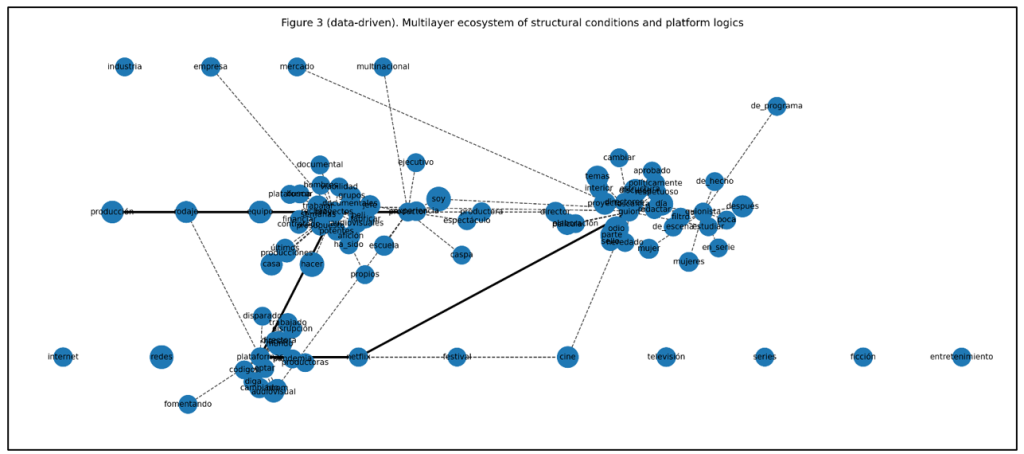
The findings converge around three interdependent dimensions. First, professionals describe online hate as an ambient threat that shapes topic selection, framing, and representational risk, especially in projects involving minorities and vulnerable groups. Second, ethical responsibility appears not as a fixed code but as a situated workflow involving collective deliberation, protection protocols, and editorial checkpoints. Third, participants describe a shift from producing stories to producing content, as funding, commissioning, and distribution increasingly reward algorithmic legibility, speed, and engagement-friendly formats.
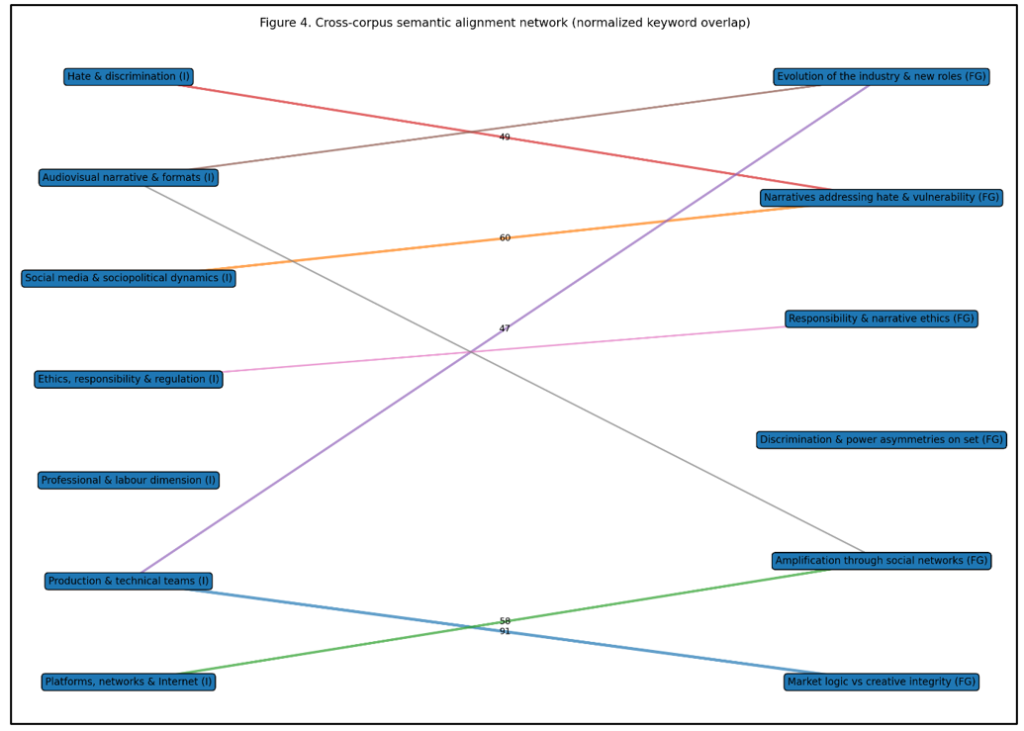
Building on this evidence, the paper proposes a strategic framework for empathy-oriented narrative interventions against digital intolerance: design-level practices grounded in testimony, context, and moral complexity; production-level safeguards based on consent, protection, and verification; circulation strategies that are aware of platform logics; and monitoring mechanisms that help anticipate flashpoints in reception and moderation. Overall, the study argues that empathy should be understood not as a vague sentimental effect, but as an operational and designable narrative practice capable of countering online hate under conditions of platformised pressure.