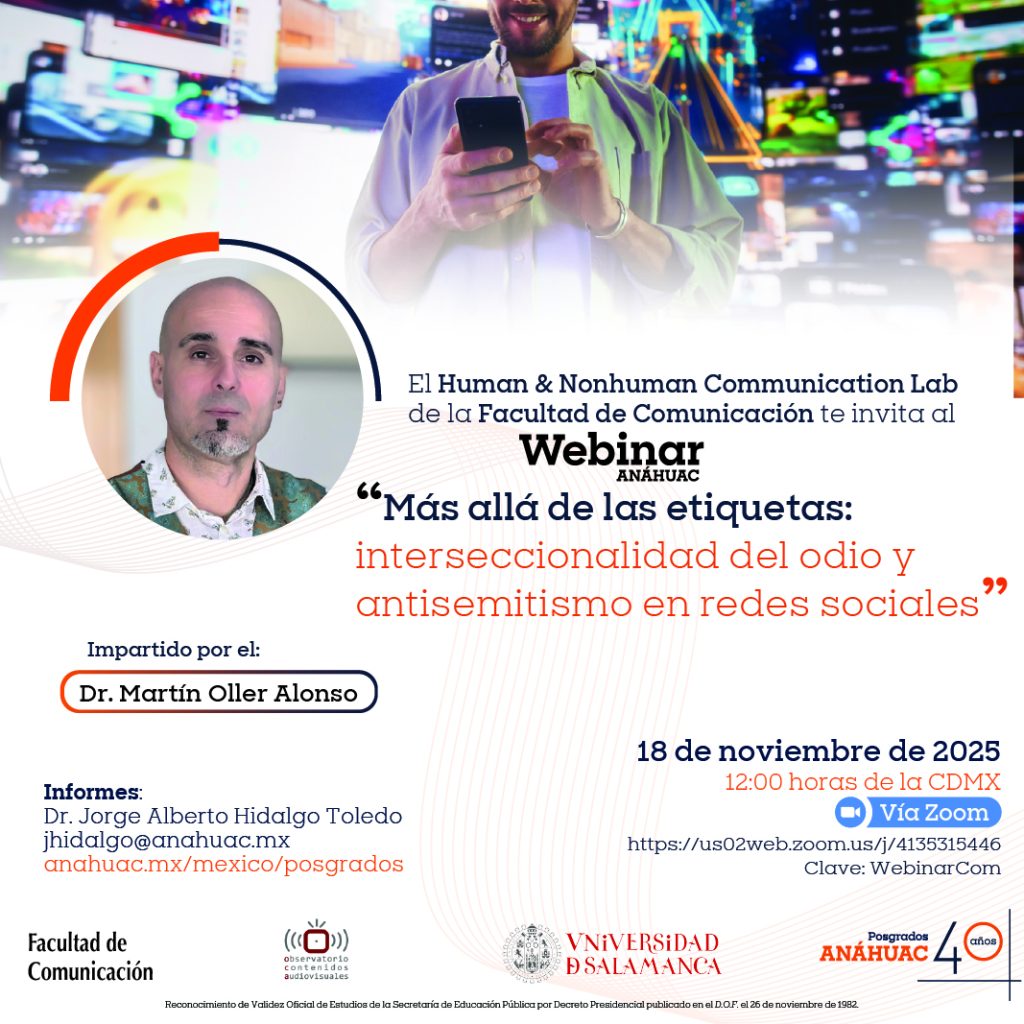
On 18 November 2025, the Human & Nonhuman Communication Lab of the Faculty of Communication at Universidad Anáhuac México, in collaboration with the Observatorio de los Contenidos Audiovisuales (OCA) (University of Salamanca) hosted the webinar “Más allá de las etiquetas: interseccionalidad del odio y antisemitismo en redes sociales”.
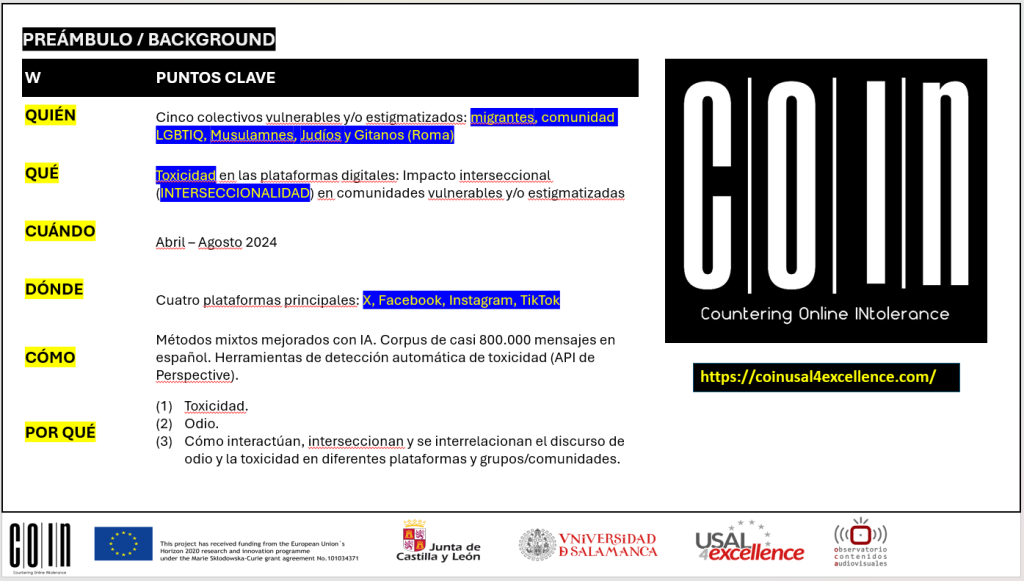
The online session was led by Dr. Martín Oller Alonso (Marie Skłodowska-Curie fellow, University of Salamanca) and formed part of the activities of the COIN project – Countering Online Intolerance against especially vulnerable groups.
Central themes of the session
During the webinar, I explored how digital antisemitism manifests on major social media platforms and how it intersects and hybridises with (anti)zionism and Islamophobia within broader dynamics of online hostility and hate.
The presentation:
Reconstructed the genealogy and typologies of antisemitism, distinguishing traditional, racialised and contemporary/neo-antisemitic narratives. Differentiated antisemitic hate from legitimate political criticism of Israeli state policies, engaging with current operational definitions (IHRA, JDA, Nexus) and the controversies surrounding their interpretation and political use.
Placed these phenomena in the European legal and policy framework on racism, xenophobia and victims’ rights, as well as recent EU and Council of Europe strategies against antisemitism and hate crime.
Showcased empirical insights from the COIN project, highlighting how antisemitic narratives circulate, mutate and overlap with other forms of hate in digital environments, and what this implies for platform governance, regulation and civil-society responses.
The talk was delivered in Spanish and sparked a rich discussion on methodological challenges, ethical dilemmas, and practical strategies for addressing antisemitism and intersecting hatreds online.
This webinar strengthened the collaboration between Universidad Anáhuac México and the University of Salamanca. It contributed to ongoing debates on AI governance, hate-speech detection and the protection of vulnerable communities in contemporary digital communication.