The European project COIN – Countering Online INtolerance against Especially Vulnerable Groups officially concluded on 30 April 2026, after completing a comprehensive programme of research, technological development, empirical analysis and social transfer aimed at detecting, understanding and countering online hate speech against especially vulnerable groups in Spain.


The European project COIN – Countering Online INtolerance against Especially Vulnerable Groups. Large-scale Monitoring and Narrative Combat of Online Hate in Spain officially came to an end on 30 April 2026, after a successful period of scientific research that began 1. november 2023, methodological innovation, technological development and social transfer. Hosted by the University of Salamanca, within the framework of USAL4EXCELLENCE and the Marie Skłodowska-Curie Actions COFUND programme, COIN has completed its planned objectives and consolidated a rigorous, interdisciplinary and socially engaged approach to one of the most urgent challenges of contemporary digital communication: the detection, analysis and countering of online hate speech against especially vulnerable groups.

Since its launch, COIN has addressed online intolerance as a complex communicative, technological and social phenomenon. The project has focused on different forms of hatred and discrimination, including racism, xenophobia, anti-Muslim hatred, antisemitism, anti-Gypsyism and LGBTIQphobia, paying particular attention to the ways in which these forms of hostility may overlap and generate intersectional configurations of digital hate. This perspective has been central to the project’s contribution: COIN has not treated hate speech merely as isolated offensive content, but as part of broader ecosystems of representation, circulation, platform visibility, intersectionality, social polarisation and symbolic exclusion.
The project was funded under H2020-MSCA-COFUND-2020-USAL4EXCELLENCE-PROOPI-663, with Grant Agreement No. 101034371, and was developed at the Department of Sociology and Communication of the University of Salamanca, in close connection with the Observatory for Audiovisual Contents (OCA). The research was supervised by Prof. Dr Carlos Arcila Calderón, with Dr Martín Oller Alonso as principal researcher of the COIN project. The work also benefited from the participation and support of researchers and collaborators affiliated with the OCA and the University of Salamanca, including Dr Patricia Sánchez Holgado, Dr Javier Amores, Dr Maximiliano Frías, William González, and Marcos Barbosa, among others.

Over the course of its implementation, COIN fulfilled its main objectives: to develop tools for the automatic detection and monitoring of different forms of online hate speech; to analyse the characteristics, patterns and dynamics of hate dissemination in Spain; and to design, test and transfer narrative-based strategies aimed at reducing the impact of hate content and fostering more empathetic, responsible and inclusive forms of communication.
One of the central pillars of the project has been the development of a hate content detection tool, designed to identify and monitor hate speech across digital environments. This technical dimension combined computational methods, natural language processing, machine learning and big data approaches. The project used models such as BERT, alongside other machine learning techniques, to classify, analyse, and detect hateful content linked to different target groups. This technological component was not conceived as an isolated output, but as part of a broader methodological architecture that connects automatic detection, empirical validation, critical interpretation, and social application.
COIN has also produced a relevant empirical and conceptual contribution to the study of online hate in Spain. The project has helped to clarify how hate speech circulates through digital platforms, how it is intensified by certain communicative and algorithmic logics, and how it interacts with stereotypes, disinformation, cultural prejudice and social vulnerability. In this sense, COIN has contributed to understanding online hate not only as a problem of detection, but also as a problem of narrative construction, public representation and democratic coexistence.
A particularly important result of the project has been the publication of the HORIZONTE COIN report. Audiovisual narrative practices to counter hate speech, conceived as a transfer-oriented output that translates the project’s research findings into practical criteria, recommendations and resources for the audiovisual sector, higher education, civil society organisations and public communication. Based on qualitative work with professionals from the Spanish audiovisual sector, the report offers tools to identify risks of stigmatisation, avoid the reproduction of harmful stereotypes and promote more ethical, complex and socially responsible narratives.
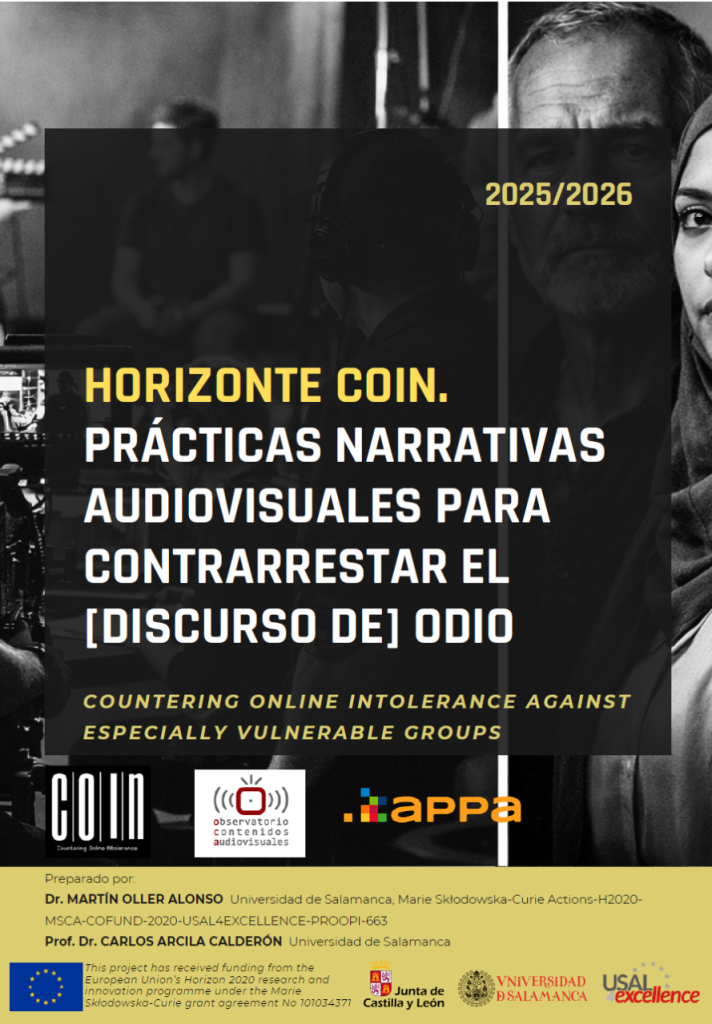
This report represents one of COIN’s major contributions to social transfer. Its objective is not limited to describing the problem of online hate. It provides practical guidelines for scriptwriting, production, editing, platform circulation, professional decision-making, higher education training, risk prevention and impact assessment. In doing so, Horizonte COIN connects academic evidence with professional practice and offers a framework for transforming research results into concrete tools for narrative intervention.
The public culmination of this line of work took place on 30 April 2026 at the University of Murcia, where the seminar-workshop Horizonte COIN. Audiovisual narrative practices to counter hate speech was held at the Faculty of Communication and Documentation. The event was organised in collaboration with the University of Murcia, the Al Fanar Foundation, the University of Salamanca, the Observatory for Audiovisual Contents (OCA) and the European project COIN, within the framework of USAL4EXCELLENCE.
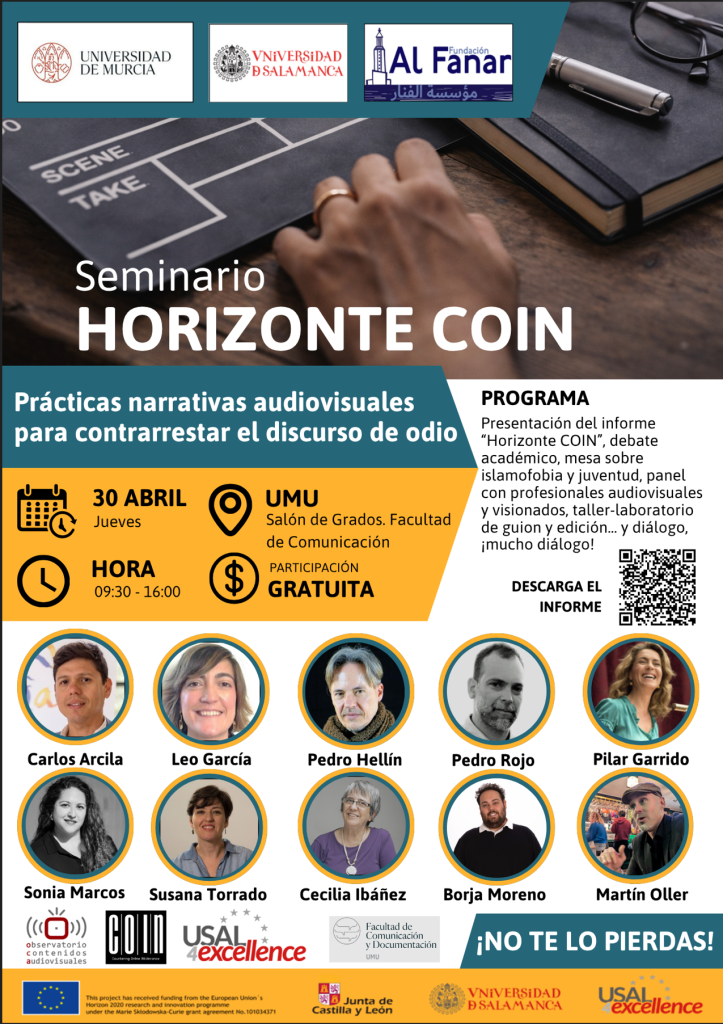
The seminar provided a space for academic, professional and social dialogue. It included the presentation of the Horizonte COIN report, a debate on research, teaching and the management of vulnerability in higher education, a roundtable on Islamophobia, media, gender and youth, a professional panel with critical screenings, and a practical scriptwriting and editing laboratory. This final event clearly reflected one of the core ambitions of COIN: to move from diagnosis to intervention, and from academic research to usable tools for education, audiovisual creation, social awareness, and intercultural coexistence.
The collaboration with the Al Fanar Foundation has been especially relevant in the project’s work on Islamophobia and anti-Muslim hate. Al Fanar contributed its expertise in intercultural mediation, media monitoring, Arab and Islamic cultural knowledge, and public awareness initiatives. This collaboration allowed COIN to reinforce its analysis of Islamophobia as a specific yet interconnected form of online hatred, and to situate this work within broader discussions on media representation, youth, gender, platform dynamics and intersectional discrimination.
The University of Murcia also played an important role in the final transfer phase of the project by hosting the closing seminar and facilitating dialogue between researchers, students, audiovisual professionals and civil society actors. This collaboration strengthened the project’s ability to connect European research with regional, local and professional contexts, particularly in relation to the training of future communicators and the development of more responsible audiovisual practices.

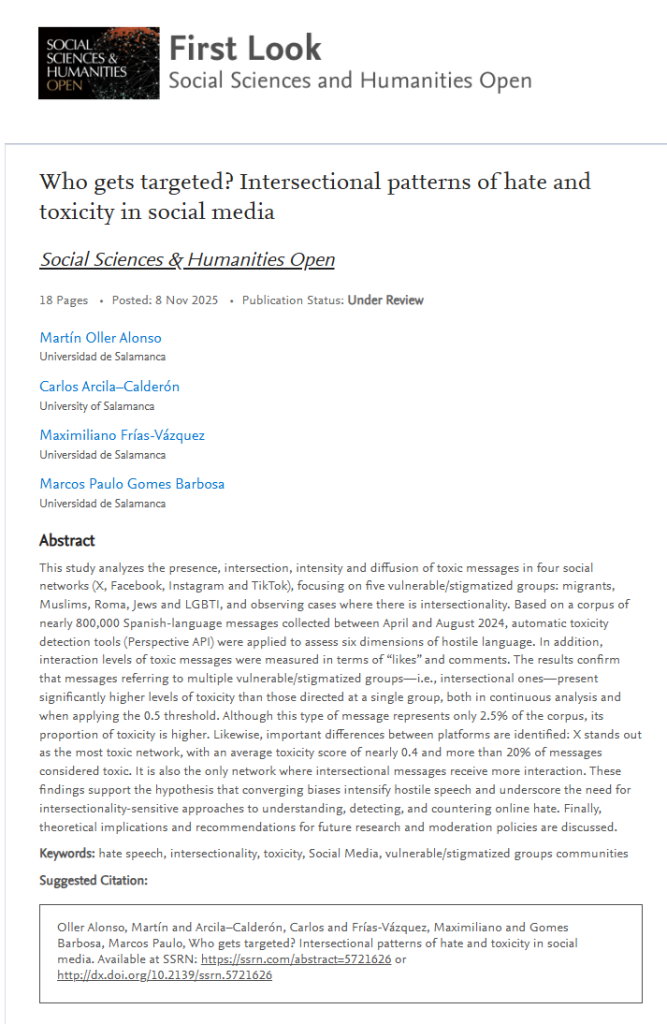
Throughout its implementation, COIN has generated scientific outputs, public dissemination activities, methodological tools, reports, seminars and transfer materials. Its results contribute to three interconnected levels. First, the project advances scientific knowledge on hate speech, vulnerable groups and digital communication. Second, it supports methodological innovation through computational detection, empirical analysis and intersectional approaches to online hate. Third, it reinforces social transfer through practical recommendations, professional training, public events and resources aimed at preventing the reproduction of discriminatory narratives.
The project’s completion, therefore, marks not only the end of a funded research period but also the consolidation of a line of work with clear continuity. COIN leaves behind tools, datasets, analyses, conceptual frameworks and applied materials that can inform future research, educational programmes, professional protocols, public policies and civil society interventions against online hate.
We would like to express our sincere gratitude to all the institutions, researchers, professionals and participants who made this project possible. Our thanks go first to the University of Salamanca, the Department of Sociology and Communication and the Observatory for Audiovisual Contents (OCA) for hosting and supporting the project. We also thank USAL4EXCELLENCE, the Marie Skłodowska-Curie Actions, the European Union and the Regional Government of Castilla y León for providing the institutional and financial framework that enabled this research.
We extend our gratitude to the Al Fanar Foundation for its essential collaboration in the analysis of Islamophobia and intercultural communication, and to the University of Murcia and its Faculty of Communication and Documentation for hosting the final seminar-workshop and contributing to the public transfer of the project’s results. Not only that, but we also thank all the audiovisual professionals, academics, students, social organisations, and participants who contributed to interviews, focus groups, seminars, workshops, and dissemination activities.
COIN concludes with its objectives successfully achieved. It has developed tools for detection, produced empirical knowledge, generated applied recommendations, and opened spaces for dialogue among academia, technology, the audiovisual sector, and civil society. Its central contribution lies in demonstrating that countering online hate requires a multidimensional response: technical, empirical, ethical, narrative, institutional and social.
The formal end of COIN on 30 April 2026 marks an important stage in European research for Martín Oller Alonso, but it also opens a new phase of continuity, application, and transfer. In a digital ecosystem marked by polarisation, disinformation and the stigmatisation of vulnerable groups, the project leaves a clear message: detecting hate is necessary, but it is not enough. We must also understand its logics, intervene in its narratives and build forms of communication capable of strengthening empathy, responsibility and democratic coexistence.